Guide 06 · Last verified 12 September 2026
Don't buy the dream home first
Buy the first rung, then climb.
Your first home does not need to be the home you want at 40. It needs to put you in a stronger spot when you turn 40.
Save diligently, secure a sound starter property, and build compounding equity. The interactive ladder below models the complete thesis in thirty seconds.
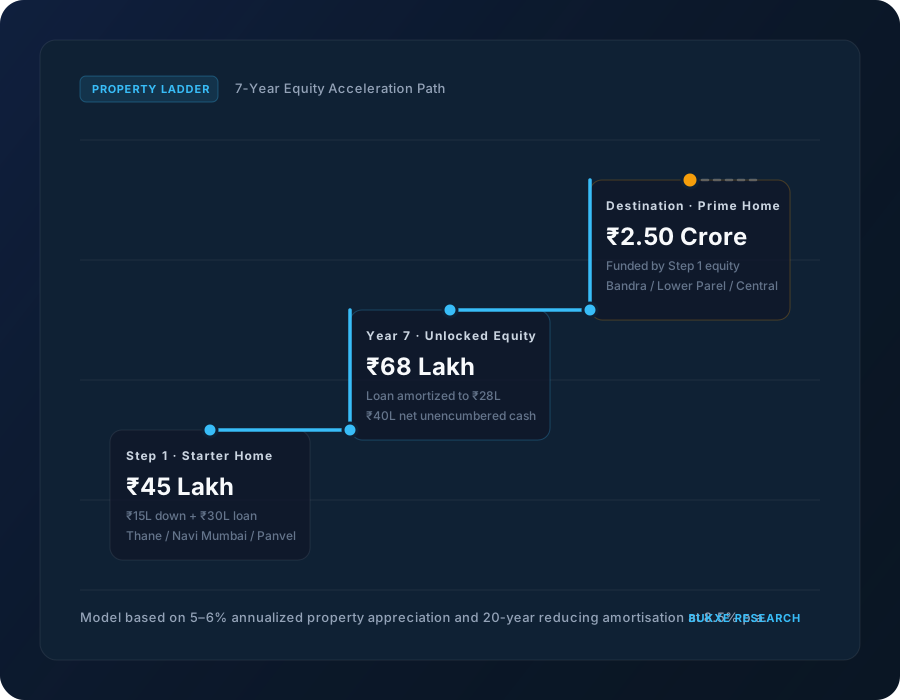
Thane before Bandra. A 1 BHK before the 2 BHK. A ladder rung before the dream.
Step 1
Name the trap
Dream home or nothing is a false choice
Step 2
Buy the rung
Tangible equity you can comfortably carry
Step 3
Compare paths
First rung vs disciplined rent and SIP
Run your starter home numbers
Model purchase price, mortgage amortization, rental yields, and wealth accumulation over 5 to 10 years.
Dream home
₹2.50 Cr
26.0x your annual income (destination)
Possible first rung
₹45.0L
₹15.0L cash + ₹30.0L loan
Estimated EMI
₹25,093/ month
31% of monthly take-home. Floating loans allow prepayments without penalty.
Age 27 to 34 Equity Outlook
Asset Value
₹67.7L
Loan Remaining
₹24.3L
Net Equity
₹43.4L
Equity represents current valuation minus outstanding principal. Transaction costs and taxes are factored in the Buy vs Invest view.
The trap is dream or nothing
01Many young buyers start with the wrong test: Can I afford the house I ultimately want? A 2 BHK in prime Mumbai at ₹2 to 3 crore fails that test instantly. So the mind concludes property ownership is impossible.
That test confuses the destination with the starting point. You may be unable to carry a ₹3 crore home today while being fully capable of managing a sound ₹40 to 50 lakh asset. Those are fundamentally different financial problems. Moving forward beats standing still, provided the first step is financially prudent.
Start where you stand
02Many professionals hold ₹15 lakh in savings, dream of a central 2 BHK, buy nothing, and watch liquid savings gradually disperse into gadgets, vacations, and car payments. The missed opportunity was not failing to catch a speculative unicorn deal; it was never evaluating a ₹40 to 45 lakh starter option on its own merits.
Think Thane instead of Bandra. Panvel or Navi Mumbai instead of Lower Parel. A compact 1 BHK instead of a dream 3 BHK. Disciplined savings turn into a starter home. The mortgage forces equity accumulation. That equity becomes the down payment for the long-term family home.
How a ₹45 lakh rung builds equity
03Banks fund up to 80% to 90% of home purchases under RBI loan-to-value limits for smaller ticket sizes. You cannot purchase ₹45 lakh of equity mutual funds with a low-cost, 20-year amortizing loan. But you can control a ₹45 lakh tangible asset with ₹10 to 15 lakh down plus a mortgage.
At 8.5 percent over 20 years, a ₹35 lakh loan requires roughly ₹30,300/month. ₹15,000 to ₹18,000 in rental yield covers more than half of the monthly carrying cost. After 7 years, roughly ₹28 lakh of debt remains, while modest asset growth of 4% to 6% lifts total valuation to ₹59L to ₹68L, leaving substantial unencumbered equity. Leverage magnifies gains, but it also magnifies errors if you buy an illiquid project.
The EMI shrinks as your earnings grow
04Fixed or benchmarked debt holds roughly steady in rupee terms while your income compounds. On ₹80,000/month, a ₹25,000 EMI commands 31 percent of net income. As your career matures to ₹1.6 lakh, that same EMI drops to 16 percent. At ₹2.5 lakh, it becomes 10 percent background noise.
In your late twenties you have three working decades ahead. Evaluate the carrying cost against your next stage of earning capacity, not solely today’s junior compensation. Indian floating loans allow fee-free prepayments, enabling rapid debt acceleration during bonus years.
When the rung is wrong
05A bad rung is infinitely worse than no rung at all. A stalled development in a location with weak tenant demand, poor arterial connectivity, or legal encumbrances still incurs interest, maintenance dues, municipal taxes, and stamp duty. And you cannot liquidate a fraction of a flat when you need liquidity.
Do not commit if your household income is volatile, if closing the deal drains all emergency reserves, if the capital is needed within 2 to 3 years, or if the investment relies entirely on optimistic developer promises. A sound first rung accelerates your journey; a compromised rung anchors you down.
- What carrying cost can I comfortably support today?
- Does the micro-market have genuine end-user tenant demand?
- Does the acquisition outperform disciplined renting plus equity investing?
Where you live and what you own are separate financial decisions.
Rent near your workplace in central Mumbai for quality of life. Own an asset in an expanding corridor with superior infrastructure growth. A mortgage enforces disciplined savings for buyers whose cash would otherwise dissolve into lifestyle creep; a disciplined index fund investor may still win without it. Compare the starter rung directly against your actual alternative before deciding.
Keep the source nearby
Public records, not promises.
Estimates are labelled as scenarios. Verify current lending regulations, stamp duty brackets, and registration fees on official state portals.
- NHB RESIDEX, city and micro market price indices
- ANAROCK, 2025 residential market report, MMR values
- Economic Survey 2025-26, housing upcycle and household savings
- RBI, Key Facts Statement for Loans and Advances
- RBI, FAQs on floating-rate EMI resets
This guide provides general financial information, not personalized advisory. Leverage magnifies downside risks; property transactions carry illiquidity and execution costs.
Learn home-loan basics before you apply